Report
Current edition: Q4 2026 · Updated September 2026
Executive Orders and rule changes since 2025 are opening allied markets to more U.S. defense companies, and global trade compliance decides who gets there first.
Download the full briefing →Two Executive Orders (EOs), signed in April 2025 and February 2026, set a new direction for U.S. defense sales abroad. EO 14268 calls for faster, more transparent decisions, and EO 14383 directs that arms transfers help build U.S. production capacity.
Defense Trade Solutions (DTS) is tracking eased restrictions across the former Foreign Military Sales (FMS) Only List, Third Party Transfers, Technology Release & Foreign Disclosure (TR/FD) (formerly known as Technology Security & Foreign Disclosure (TSFD)), and Missile Technology Control Regime controls. Allied demand for co-development and co-production is climbing. The opportunity is real, and so is the added complexity for the global trade teams that have to execute on it.
The strategic policy wins are in place. Industry can make the most of them only if the government's implementation holds tactical discipline. That tactical layer is where DTS sees programs slowing, and more often than not, the friction starts before a license is ever filed.
Two processes stand between a U.S. defense company and an international sale, and they answer different questions. TR/FD is the U.S. Government's policy decision on whether a technology can be released to a foreign partner, based on national security and foreign policy. Licensing under the International Traffic in Arms Regulations (ITAR) comes afterward. It's the regulatory approval to export once that release question is settled.
The name is part of the confusion. TR/FD is the term Congress used in the Fiscal Year 2024 National Defense Authorization Act, while many in government and industry still call it TSFD.
When a program stalls, most teams go after the license. In DTS's work, the holdup more often traces back to the release decision, or to a plan that never connected the two.
The full analysis is in the briefing →Step 1
Can this technology go to this partner?
Step 2
Approval to export once release is settled.
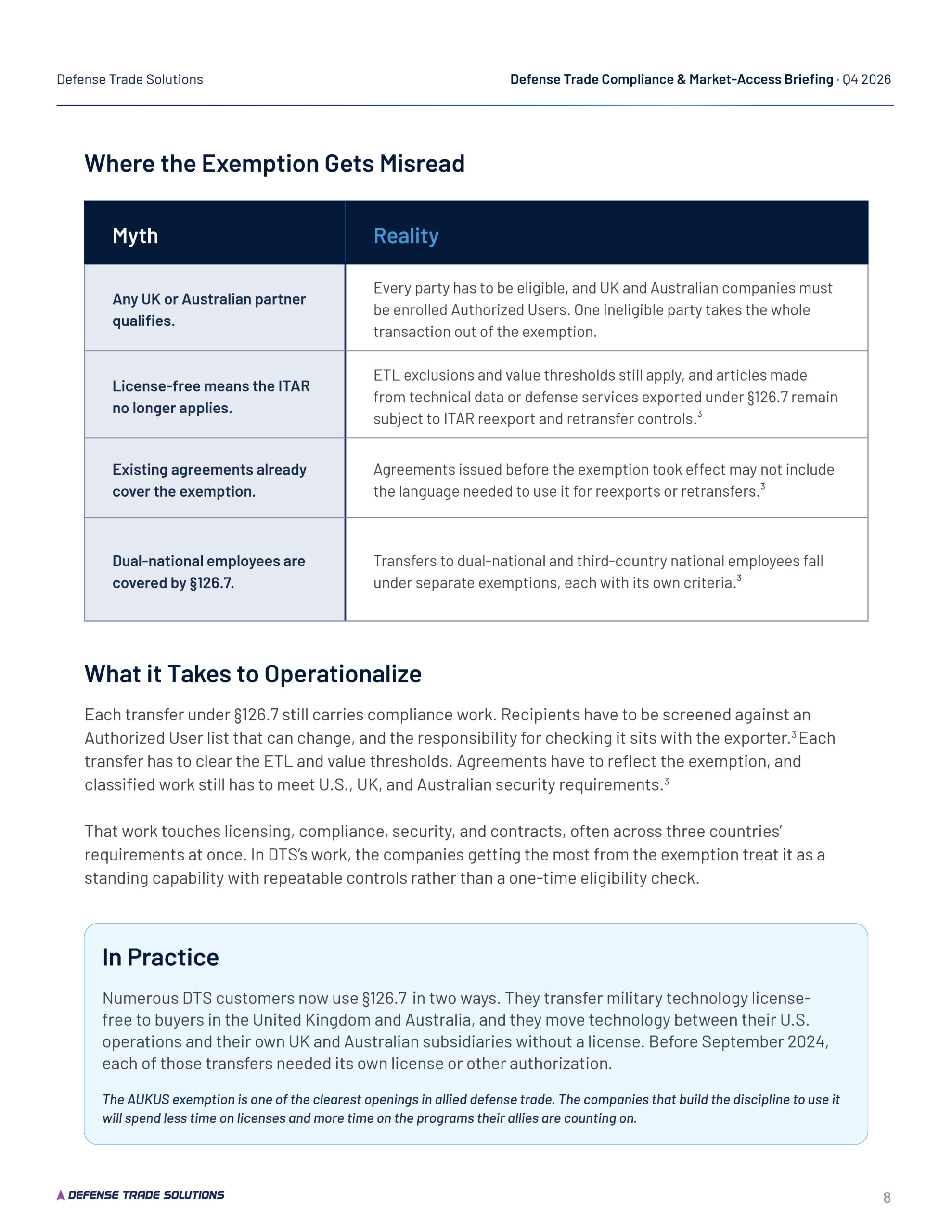
License-free trade with the UK and Australia is open to most programs.
According to the State Department, the vast majority of commercial defense trade among the three countries qualifies for the Australia, United Kingdom, and United States (AUKUS) exemption under ITAR §126.7. A final rule set its terms in December 2025. The briefing breaks down eligibility, exclusions, and the controls that still apply once the license goes away.
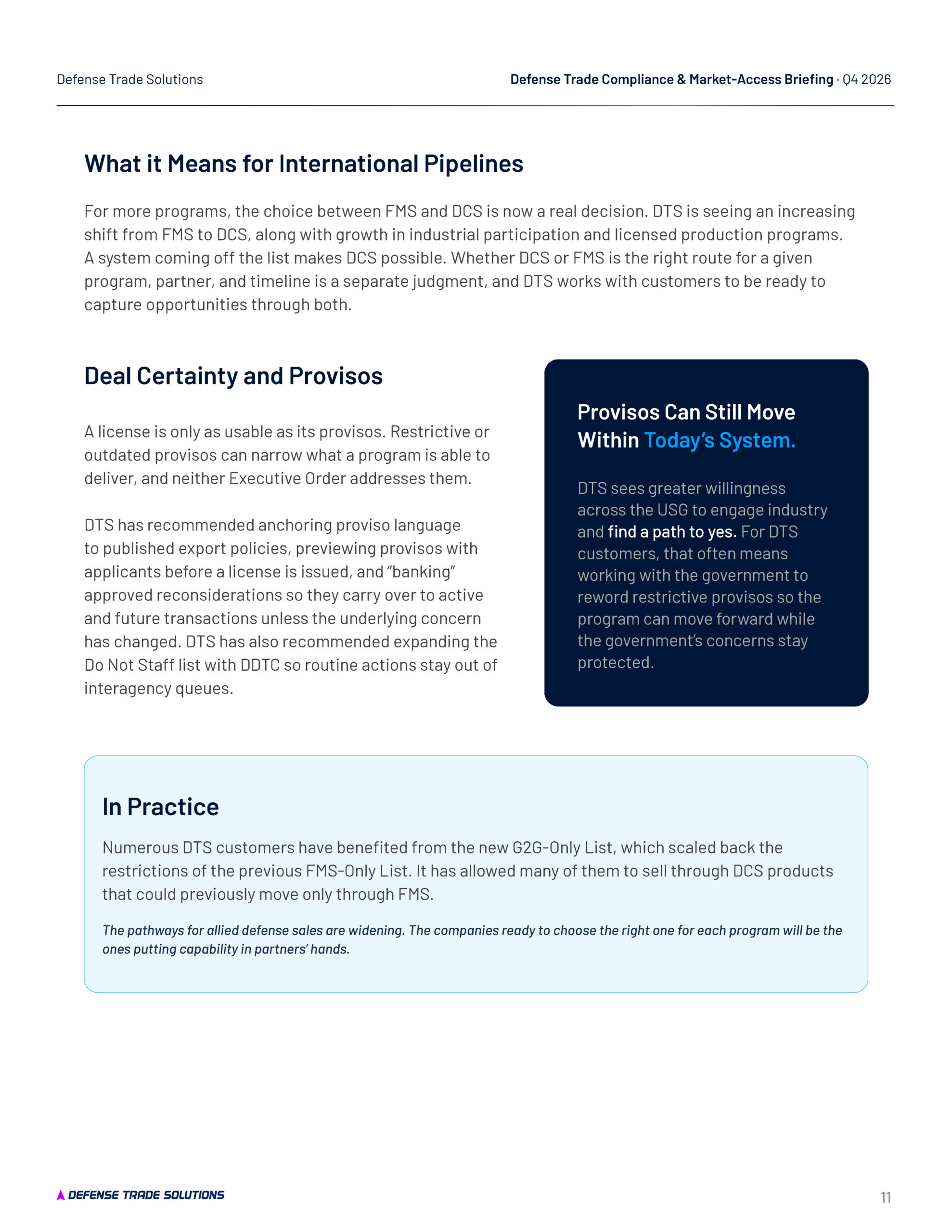
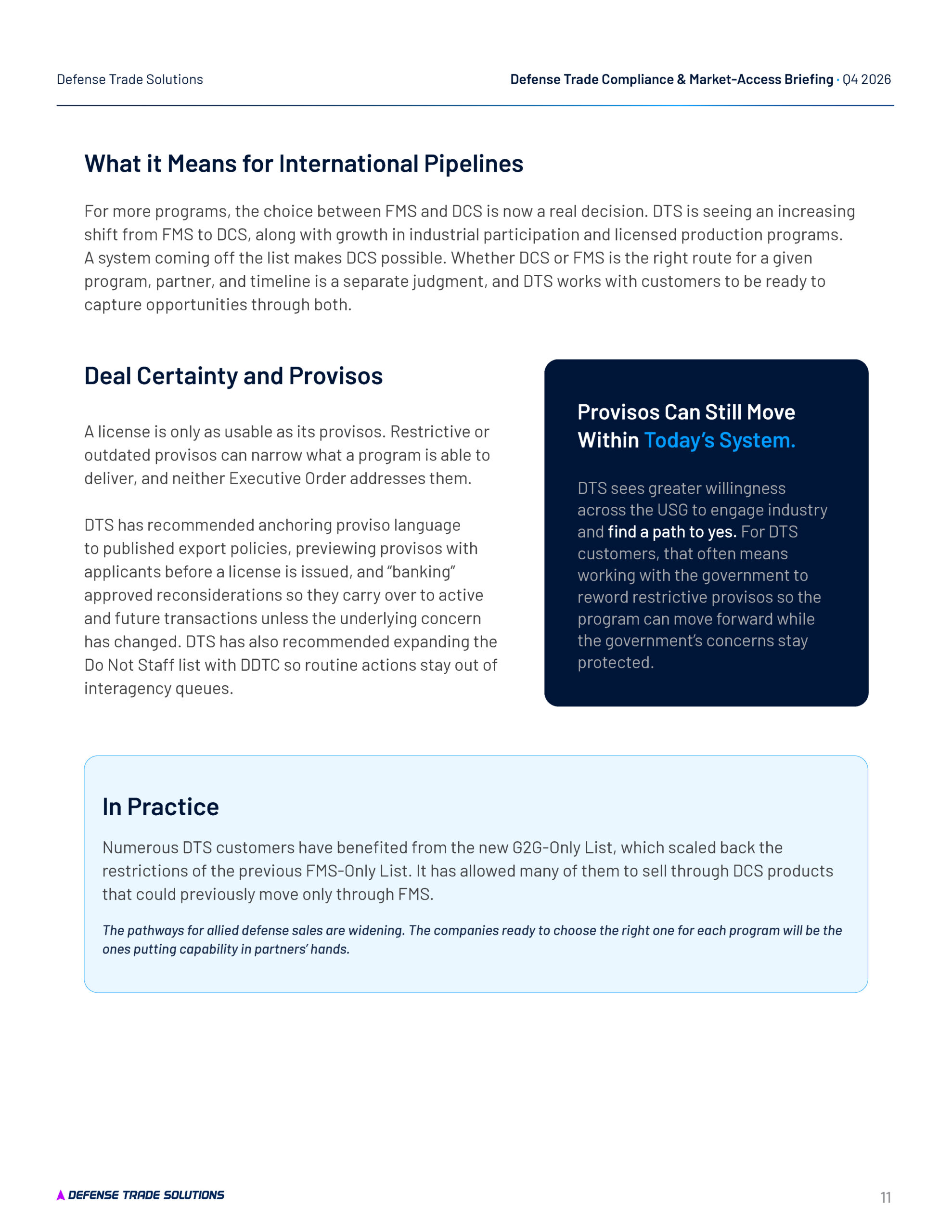
More systems once limited to FMS are now open to direct sales.
The FMS-Only List was rebuilt through a zero-based review and renamed the Government-to-Government (G2G) Only List in October 2025. Many DTS customers are now selling through Direct Commercial Sales (DCS) products that previously could move only through FMS. The briefing covers the list change, the pathway decision it creates, and why provisos still shape deal certainty.
The next gains depend on how reform is carried out.
Department of War officials told the Government Accountability Office in May 2026 that 26 of 33 planned Technology Release & Foreign Disclosure (TR/FD) (formerly known as Technology Security & Foreign Disclosure (TSFD)) reform items were complete, with the rest on track for November 2026. DTS has recommended further steps, including annual updates to U.S. control lists, more country-based exemptions like AUKUS, and standardized license provisos. The briefing lays out where DTS sees implementation heading and what it means for industry.
Get instant access to the Q4 2026 edition, plus a copy in your inbox for later.
Trusted by 120+ defense companies.
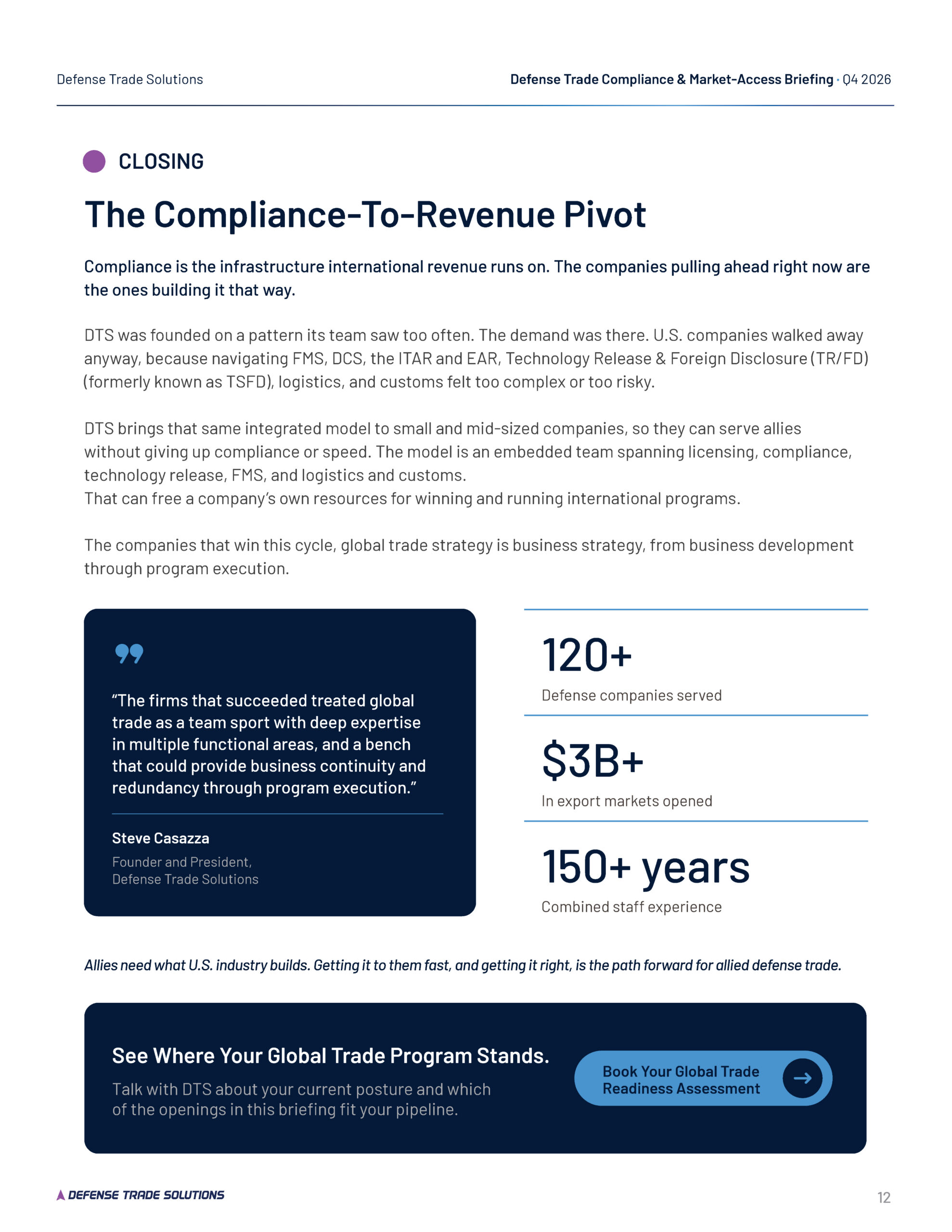
$3B+
In export markets opened
150+ Years
DTS Staff Experience
$2B+
In penalties mitigated