

Author byline: Steve Casazza, Founder & President, Defense Trade Solutions
Challenge
A mid-cap aerospace and defense company nearly walked away from a major international opportunity. Global trade compliance had never been built as its own function, so no one could confirm the deal was even exportable.
Solution
DTS built the export authorization strategy that made the bid possible, then scaled into a Managed Services partnership covering licensing, compliance, TSFD, FMS, and logistics and customs.
Outcome
Over four years: authorization timelines cut from 120 to under 60 days, roughly 200 authorizations supported, and a compliant pipeline that helped enable a multi-billion-dollar transaction.
Some of the most consequential business decisions never make it into a board deck. They happen quietly, in a single internal conversation, when a company almost says no to an opportunity it was fully capable of winning.
A mid-cap aerospace and defense company nearly walked away from a major international opportunity. Not because the technology wasn’t ready. Not because the customer relationship wasn’t there. Because no one inside the company could confidently answer a single question: was this even exportable?
For years, that question had never needed a real answer. Global trade compliance had been treated as paperwork, something to hand off to finance and contracts staff already stretched thin on other priorities. It had never been asked to carry the weight of a major international opportunity before. This time, it was, and the company was seriously considering a no-bid rather than find out.
Problem: The compliance gap
Inside the company, global trade compliance had never been built as its own function. It was treated as an administrative box to check, so it lived inside finance and contracts, alongside responsibilities those teams were already managing.
The cost of that structure showed up in familiar ways. License applications came back rejected. Real regulatory risk went unaddressed simply because no dedicated function existed to catch it. Processing times stretched long. In some cases, the company turned away business altogether, because pursuing it under the existing process felt too difficult to justify.
The clearest symptom of all this was a 120-day authorization timeline. But the timeline was never really the issue. It reflected something underneath it: no formal process for handling export authorizations, no dedicated staff focused on the discipline, and no in-house expertise to guide it. Addressing the timeline directly wouldn’t have solved anything. Addressing what was actually missing would.

The opportunity that exposed the gap
A European ISR aircraft opportunity put that gap to the test.
It was significant enough that a no-bid decision was seriously on the table. Without a formal export authorization strategy in place, and without confidence in the company’s own compliance posture, there was no clear path to bidding at all.
That decision point is what brought DTS into the relationship. Not to write a license faster. To determine whether the opportunity was viable, and if it was, to build what the company needed to pursue it with confidence.
Solution: The TAA Playbook
Once the opportunity was on the table, DTS didn’t start with paperwork. It started with a strategy.
A Technical Assistance Agreement, or TAA, authorizes a U.S. company to share controlled technical data or defense services with a foreign partner. Any contractor pursuing an international opportunity involving sensitive technology needs one, and the strength of that agreement, how precisely it’s scoped, how well it anticipates the USG’s questions, determines whether the approval comes back quickly with minimal restrictions, or slowly with provisos that make the business harder to execute.
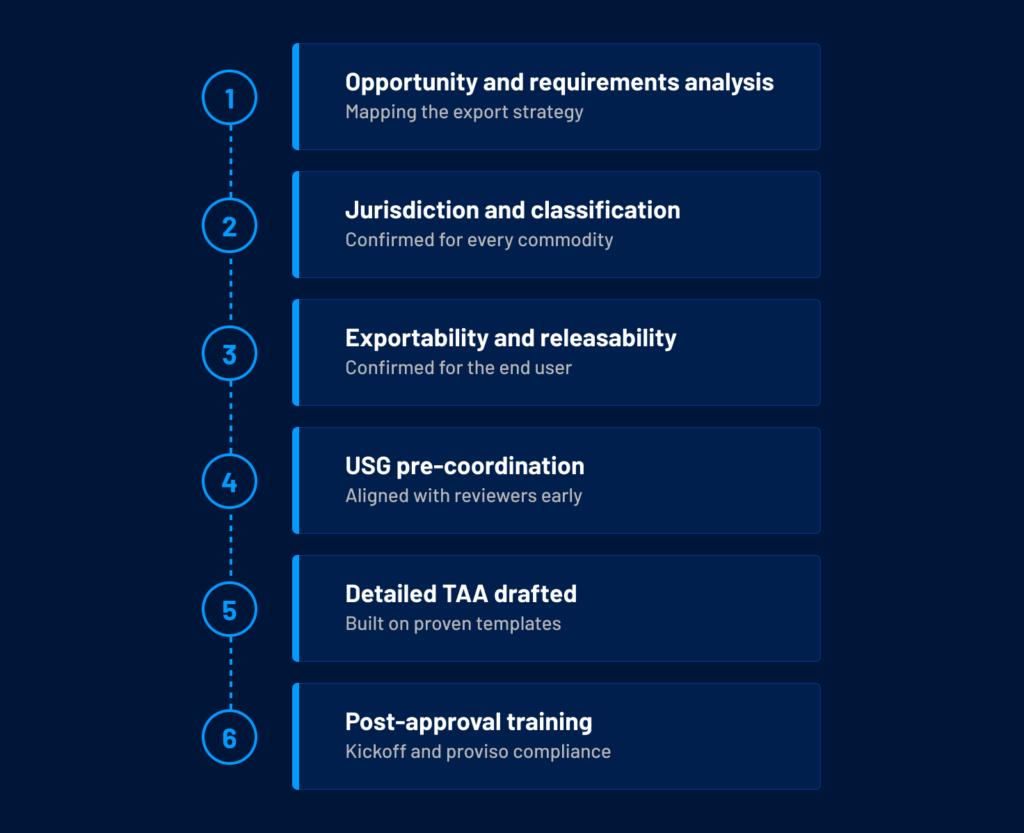
DTS built the company’s TAA around six steps.
- Opportunity and requirements analysis. DTS started by mapping the specific export authorization strategy the opportunity required, rather than applying a one-size-fits-all compliance checklist to a deal with its own particular risks and requirements.
- Jurisdiction and classification determinations. Every commodity involved in the sale, across the full program, was evaluated to confirm its jurisdiction and classification. This step is the foundation everything else depends on. Get it wrong, and the rest of the agreement is built on sand.
- Exportability and releasability confirmation. DTS confirmed that the aircraft and its mission equipment were, in fact, exportable and releasable to the intended end user, closing the exact uncertainty that had put the bid at risk in the first place.
- USG pre-coordination. Rather than submitting the request cold and waiting, DTS pre-coordinated the effort directly with the U.S. government, positioning reviewers to work the approval efficiently once it was formally submitted.
- A detailed TAA, built on proven templates. DTS drafted the agreement using methodology refined across hundreds of prior authorizations, scoped with the level of precision that reduces both processing time and the likelihood of restrictive provisos.
- Post-approval training. Once the TAA was approved, DTS didn’t hand over a document and move on. DTS conducted a full kickoff briefing and proviso-compliance training for the program personnel who would be living with the agreement day to day, so the team understood its recordkeeping, reporting, and compliance obligations from day one, not after the fact.
The TAA was submitted with that groundwork already in place.
The Managed Services Model
Solving the immediate opportunity solved one deal. It didn’t solve the underlying problem, that global trade compliance still had no permanent home inside the company.
Rather than build a compliance function from scratch, the company scaled through DTS’s Managed Services model instead. DTS embedded a fractional team of subject matter experts spanning licensing, compliance, technology security and foreign disclosure (TSFD), Foreign Military Sales (FMS), and logistics and customs compliance, growing toward full FTE-level support as the company’s international portfolio expanded.
That structure gave the company a full bench of specialists rather than a single generalist hire covering ground they’d never worked before. Five disciplines, one engagement, at a cost well below what five separate specialist hires, or even one fully-burdened senior in-house generalist, would run.
The bigger shift was where the company’s own resources went next. With global trade compliance covered, the company invested its internal resources in international business development, government relations, contracts, and program management, the functions that actually drive growth, rather than diverting budget and attention into standing up a compliance team internally. That reallocation is what let the company scale its international business from a standing start into one of the more competitive mid-cap aerospace and defense companies operating internationally.
Outcome: The results
The TAA was approved quickly, with minimal provisos. The company bid on the opportunity it had nearly walked away from.
That outcome sat inside a broader pattern of results. Over four years, DTS supported roughly 200 authorizations for the company, spanning ITAR and EAR license types, first-time licenses, amendments, exemptions, exceptions, agreements, and brokering requests, including support extended to the company’s own supply chain vendors and partners when they lacked global trade expertise of their own.
Processing timelines fell from 120 days to under 60, cutting authorization time by more than half. That shift reflected a posture change as much as a speed change: rather than reacting to compliance requirements deal by deal, the company could now pursue both Foreign Military Sales and Direct Commercial Sales opportunities proactively, with confidence in the compliance foundation underneath them.
The company grew into one of the more competitive mid-cap aerospace and defense companies operating internationally, a trajectory that would not have been possible while global trade compliance remained an unstaffed, ad hoc function. That compliant international pipeline ultimately became a material part of a multi-billion-dollar corporate transaction, the clearest evidence available that global trade compliance, built correctly, is not overhead. It is infrastructure for growth.

The bigger picture
Every company in this position believes their situation is manageable until the moment it isn’t. The gap doesn’t announce itself. It sits quietly until a major opportunity is on the table and there’s no time left to close it.
DTS has the depth, the government relationships, and the track record to get you to yes before the opportunity is gone.
Not sure where your compliance program stands today?
Schedule a consultation with DTS →